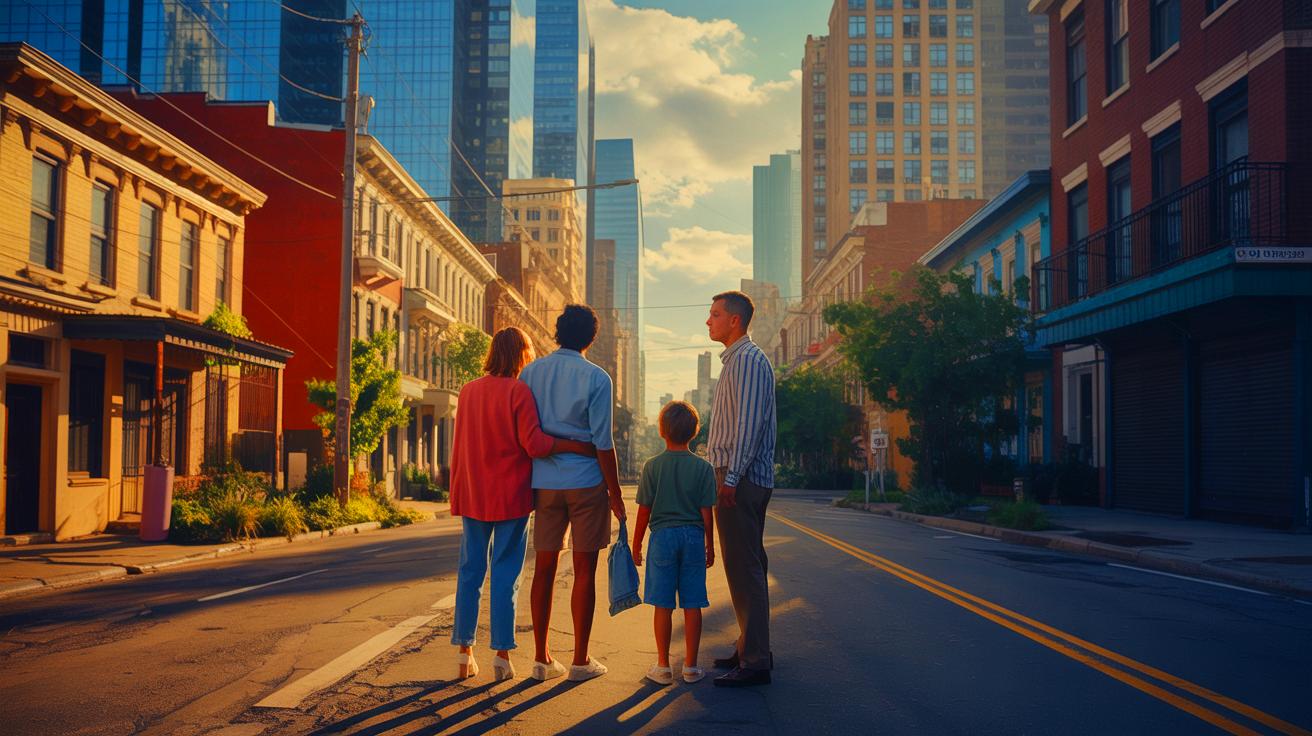
What you need to know
- 🏙️ Gentrification as a Double-Edged Sword: While it revitalizes urban areas, gentrification often displaces long-term residents, making neighborhoods unaffordable for the original inhabitants.
- 💔 Emotional and Financial Impact on Families: Displacement disrupts family life, leading to emotional instability and financial strain as they seek affordable housing and adapt to new environments.
- 🏛️ The Role of Policy and Urban Planning: Effective urban planning and policies, like inclusionary zoning and rent control, are crucial in mitigating the adverse effects of gentrification on existing residents.
- 🤝 Community Responses and Resilience: Grassroots movements and community organizations advocate for residents’ rights, promoting social justice and creating solutions like cooperative housing to counter displacement.
The phenomenon of gentrification is sweeping across major cities, leading to profound changes in urban landscapes. While it often brings economic revitalization and aesthetic improvements, the social cost is substantial, particularly for families who find themselves being forced out of their neighborhoods. This article delves into the realities faced by these families, highlighting the emotional and financial toll of being uprooted from communities they have called home for generations. As we explore the complex dynamics of gentrification, it becomes clear that the benefits are often unevenly distributed, leaving many to question the true cost of progress.
The Gentrification Wave: A Double-Edged Sword
Gentrification, characterized by the influx of wealthier residents into historically lower-income neighborhoods, is a double-edged sword. On one side, it breathes new life into urban areas, attracting businesses and increasing property values. On the other, it often displaces long-term residents who can no longer afford the rising costs. The transformation is both physical and social, altering the fabric of communities. As developers target these areas with the promise of modernization, the original inhabitants face a grim reality. They are caught in a cycle where their neighborhoods become desirable, yet unaffordable, forcing them to relocate to less established areas, often with fewer resources and opportunities.
Impact on Families: The Emotional and Financial Toll
For families uprooted by gentrification, the impact is profound and multifaceted. The emotional toll is significant as they leave behind not only their homes but also their communities and support networks. This upheaval disrupts children’s education and social lives, leading to a sense of instability and loss. Financially, the burden is heavy. Many families find themselves priced out of their neighborhoods as property taxes and rents skyrocket. The search for affordable housing becomes a daunting task, often resulting in longer commutes and reduced access to essential services. The strain on family resources is compounded by the need to adjust to new environments, where cultural and social connections may be lacking.
The Role of Policy and Urban Planning
Urban planning and policy play a crucial role in shaping the outcomes of gentrification. While some cities have implemented policies aimed at mitigating displacement, the effectiveness of these measures varies. Inclusionary zoning laws, rent control measures, and community land trusts are some strategies employed to balance development with equity. However, the implementation of such policies often lags behind the pace of gentrification, leaving many families vulnerable. It is essential for urban planners and policymakers to proactively address the needs of existing residents, ensuring that development does not come at the expense of community stability. Engaging with local communities in the planning process can help create inclusive environments that benefit all residents.
Community Responses and Resilience
Despite the challenges posed by gentrification, many communities are demonstrating resilience and adaptability. Grassroots movements and community organizations are at the forefront of advocating for residents’ rights and preserving the cultural heritage of neighborhoods. These groups often serve as a voice for the marginalized, pushing for policies that promote social justice and inclusivity. Community-led initiatives, such as cooperative housing and local business support networks, are emerging as viable solutions to counter displacement. By fostering a sense of solidarity and collective action, these efforts highlight the power of communities to resist and adapt to change, ensuring that progress does not erase the past.
As cities continue to evolve under the pressures of gentrification, the questions of who benefits and who loses remain central. The stories of families being forced out of their homes challenge us to reconsider the true meaning of urban development. How can we create cities that are inclusive and equitable, where growth does not come at the cost of displacement and loss? The answers lie not only in policy but in the commitment of communities to build a future that honors both progress and preservation.
Did you like it?4.4/5 (26)
Merci pour cet article! J’espère que les décideurs prennent note de ces défis. 🙏
Comment pouvons-nous équilibrer revitalisation urbaine et justice sociale ? 🤔
Je ne savais pas que la gentrification avait un tel impact émotionnel. C’est triste.
Bravo aux mouvements communautaires qui se battent pour les droits des résidents! 👏
Peut-on vraiment blâmer les nouveaux arrivants pour la montée des prix? 🤷♂️
La gentrification est-elle inévitable dans toutes les grandes villes?
Wow, je n’avais jamais vu les choses sous cet angle, c’est vraiment éclairant!
Est-ce que les politiques de contrôle des loyers sont efficaces à long terme?
J’adore l’idée de coopératives de logement pour contrer les déplacements. 🏠
Pourquoi les politiques urbaines prennent-elles autant de temps à changer? 😕
C’est incroyable de voir comment les communautés s’organisent pour résister!
Les enfants sont aussi affectés, ça doit être difficile pour eux de changer d’école.
La gentrification peut-elle réellement être contrôlée par la planification urbaine?
Une ville sans ses habitants d’origine perd son âme. C’est vraiment triste. 💔
Merci pour cet article, il met en lumière un problème souvent ignoré.