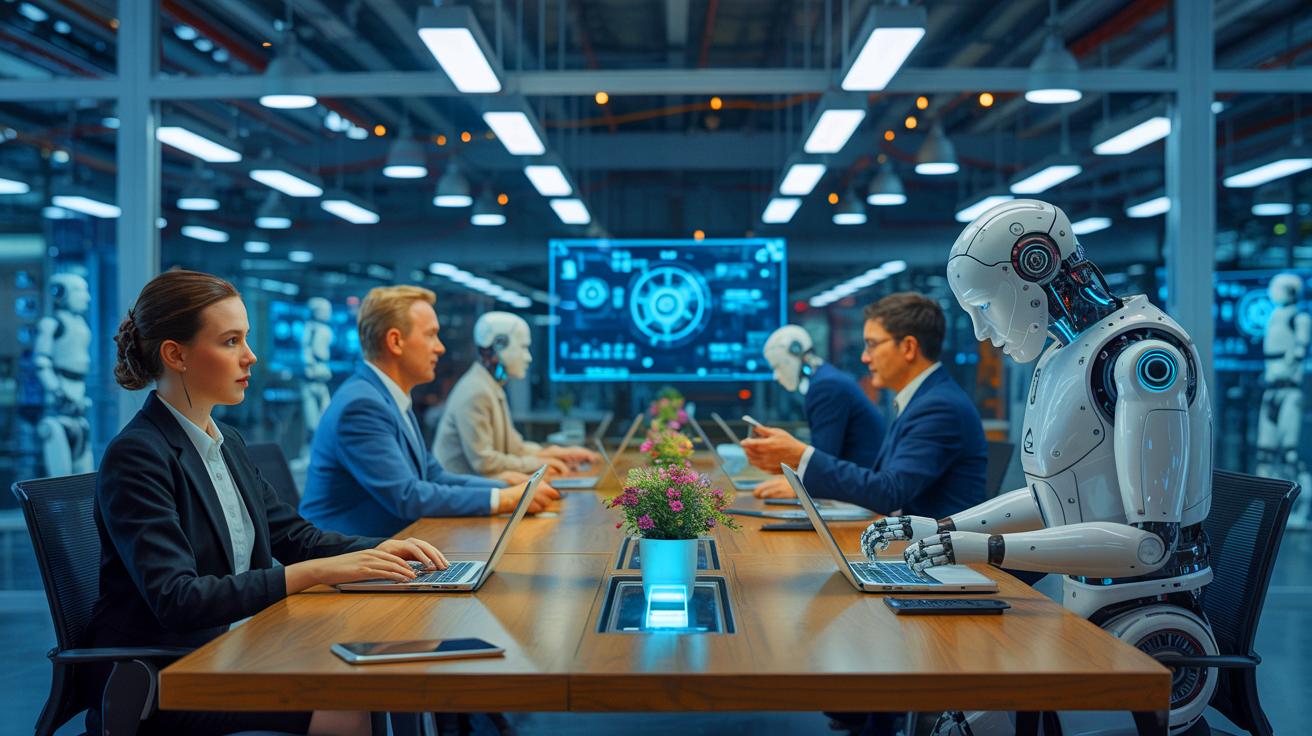
What you need to know
- 🤖 AI as a Double-Edged Sword: AI technologies offer increased efficiency and innovation but raise concerns about job displacement, especially in routine sectors like manufacturing and administration.
- 🏭 Industry Impact: Different industries experience AI’s impact uniquely, with manufacturing seeing automation replace human labor, while healthcare benefits from enhanced diagnostics and personalized medicine.
- 📚 Reskilling and Education: Adapting to an AI-driven future requires a focus on reskilling and upskilling, emphasizing STEM education and lifelong learning to prepare the workforce for new roles.
- ⚖️ Ethical Considerations: The rise of AI brings ethical challenges related to privacy, bias, and accountability, necessitating the development of guidelines to ensure responsible AI use.
- 🔮 Future Uncertainty: The future of work in an AI-dominated world is uncertain, prompting society to balance technological progress with job market stability and equitable benefits distribution.
The rapid advancement of technology, particularly in the field of artificial intelligence (AI), has sparked a global debate: Is technology taking over? As AI systems become increasingly sophisticated, there are growing concerns about their potential impact on job market stability. The fear that these technologies might replace human workers, leading to widespread unemployment, is palpable. While AI offers undeniable benefits, such as increased efficiency and the potential to solve complex problems, it also poses significant questions about the future of work. This article delves into these concerns, exploring whether AI is a friend or foe to the workforce.
The Rise of AI: A Double-Edged Sword
The rise of AI is often described as a double-edged sword. On one hand, AI technologies promise to revolutionize industries by automating repetitive tasks, enhancing productivity, and creating new opportunities for innovation. For instance, AI is being used in healthcare to assist doctors with diagnostics and in finance to detect fraudulent activities. These applications not only increase efficiency but also improve accuracy, ultimately benefiting society as a whole.
On the other hand, the capacity of AI to perform tasks traditionally done by humans raises fears of job displacement. Routine jobs, particularly those in manufacturing and administrative sectors, are at the highest risk. According to a study by McKinsey Global Institute, up to 800 million jobs could be lost to automation by 2030. This potential upheaval in the job market is causing anxiety among workers who fear becoming obsolete. The critical question remains: Can the job market adapt quickly enough to absorb displaced workers into new roles, or will the transition leave many behind?
AI’s Impact on Different Industries
AI’s impact varies significantly across different industries. In the manufacturing sector, robots and automated systems have been replacing human labor for years. This trend is expected to continue, with AI enhancing robots’ capabilities, making them even more efficient and reliable. While this reduces costs for companies, it also reduces the demand for human labor, particularly for assembly line jobs.
The service industry is also experiencing AI’s transformative effects. Virtual assistants and chatbots are handling customer inquiries, reducing the need for customer service representatives. In banking, AI is used for data analysis and decision-making, potentially reducing the need for financial analysts. However, AI also creates new opportunities, such as in AI development and maintenance roles, which require new skill sets.
In healthcare, AI is proving to be a valuable tool for diagnostics and personalized medicine. While this augments the capabilities of healthcare professionals, it also raises questions about the future role of medical staff as AI takes over more responsibilities. The net effect of AI on jobs in each industry will depend on how quickly humans can adapt to these changes and acquire the necessary skills to work alongside AI.
Skills and Education: Preparing for an AI-Driven Future
To mitigate the potential negative impact of AI on employment, there is a growing emphasis on reskilling and upskilling the workforce. As AI changes the landscape of work, the demand for skills will shift. Jobs that require creative thinking, emotional intelligence, and complex problem-solving are less likely to be automated. Therefore, education systems must adapt to emphasize these skills, ensuring that future generations are prepared for an AI-driven world.
Many experts advocate for a stronger focus on STEM (Science, Technology, Engineering, and Mathematics) education, as these fields are closely aligned with AI development. Additionally, lifelong learning will become increasingly important, as workers need to continuously update their skills to remain relevant in the job market. Governments and organizations are being called upon to invest in training programs that help workers transition into new roles that AI creates.
As society grapples with these changes, the question of who will bear the responsibility for retraining the workforce remains open. Will it fall on governments, educational institutions, or the private sector? Addressing this issue is crucial to ensure a smooth transition into the AI era.
Balancing Innovation with Ethical Considerations
As AI continues to advance, it’s crucial to balance technological innovation with ethical considerations. The use of AI raises several ethical questions, including those related to privacy, bias, and accountability. As AI systems are deployed across various sectors, ensuring they operate fairly and transparently becomes paramount. There is a risk that AI systems could reinforce existing biases if they are trained on biased data, leading to unfair treatment in areas like hiring and lending.
Moreover, the lack of transparency in AI decision-making processes can make it difficult to hold systems accountable for their actions. This has led to calls for the development of ethical guidelines and regulations to govern AI use. Policymakers, technologists, and ethicists must collaborate to establish frameworks that ensure AI is developed and used responsibly, safeguarding against its potential misuse.
As the world navigates these challenges, society must decide how to harness AI’s potential while minimizing its risks. How can we ensure that the benefits of AI are equitably distributed, and what mechanisms should be put in place to protect vulnerable workers?
The future of work in an AI-driven world remains uncertain. While the benefits of AI are undeniable, its potential to disrupt the job market cannot be ignored. As technology continues to evolve, society must grapple with the question of how to balance progress with stability. By investing in education, skill development, and ethical guidelines, we can prepare for a future where humans and AI coexist. The challenge now is to navigate this transition effectively. Will we rise to the occasion and create a world where technology enhances human potential, or will we allow it to widen existing inequalities and create new challenges? The answer lies in the choices we make today. What will our collective future look like in a world increasingly dominated by AI?
Did you like it?4.5/5 (26)
Je trouve cet article très intéressant! Ça fait réfléchir sur notre avenir avec la technologie. Merci pour cette analyse. 😊
Est-ce que l’IA est vraiment capable de remplacer des emplois créatifs aussi, ou est-ce que c’est juste pour les tâches routinières?
Je pense que c’est le moment idéal pour apprendre de nouvelles compétences et se préparer pour l’avenir. Qui est avec moi? 😄
Merci pour cet article! J’espère que les entreprises investiront dans la formation continue pour leurs employés.
Si l’IA prend nos emplois, est-ce qu’on aura plus de temps libre ou c’est juste un rêve?
Je suis curieux de savoir comment l’IA va transformer le secteur de la santé. Ça pourrait être révolutionnaire!
Les robots qui remplacent les humains, c’est un peu effrayant, non? Je me demande quelles seront les conséquences à long terme.
Est-ce que quelqu’un a déjà suivi une formation pour travailler avec l’IA? Des recommandations?
Je suis d’accord avec l’importance de l’éducation STEM. Mais comment faire pour que tout le monde ait accès à ces ressources?
Merci pour cet éclairage sur les considérations éthiques. C’est crucial d’en parler pour éviter les dérives.
Haha, bientôt on aura tous des assistants robots, mais qui va réparer ces robots quand ils tomberont en panne? 🤔